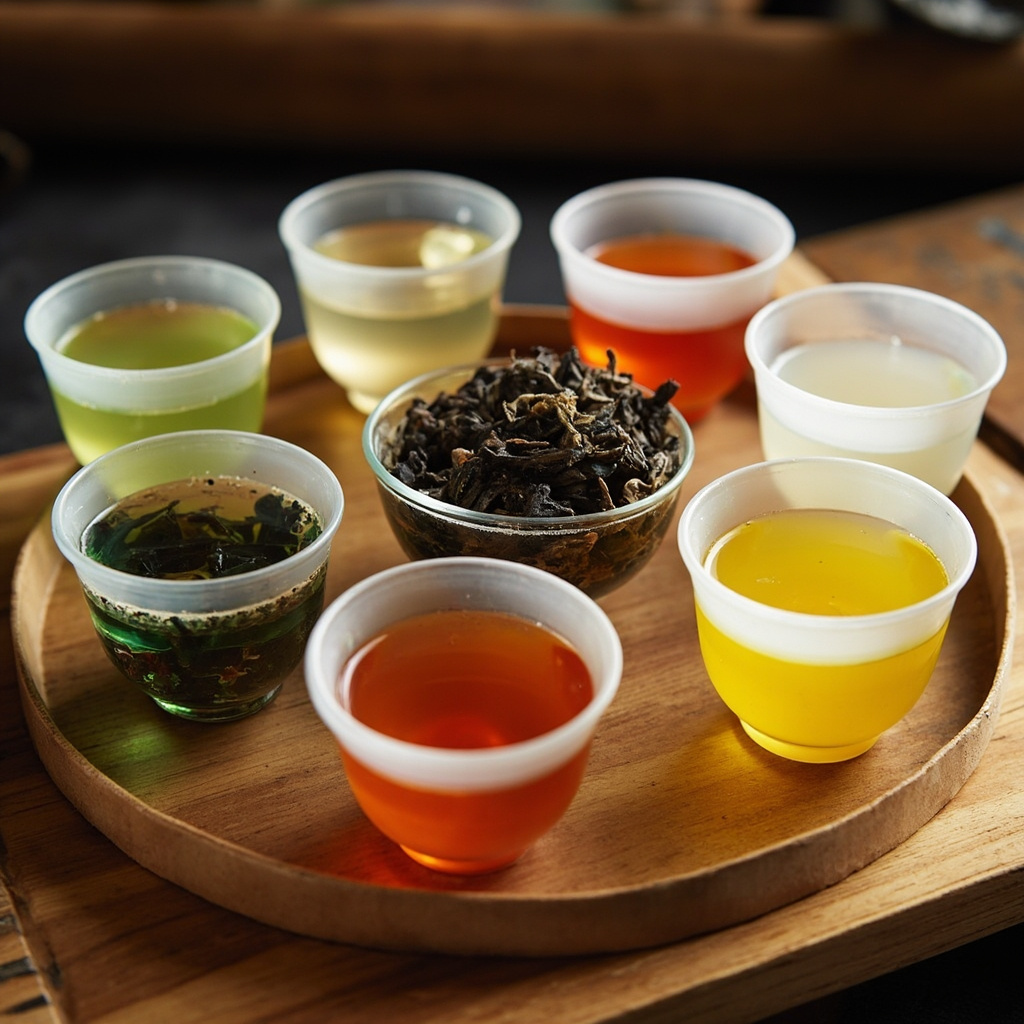
The same Camellia sinensis leaf, picked on the same morning from the same bush, could become any of six completely different teas. What changes is not the leaf — it is what the tea maker does with it. Oxidation. Heat. Rolling. Fermentation. These four variables, applied in different sequences and degrees, produce the entire universe of Chinese tea.
Here is your map to that universe — from the lightest green to the darkest, most aged pu'er. Each family, explained.
① Oxidation 0%
Green Tea 绿茶
lǜ chá
The Original
The freshest thing you can drink. Green tea leaves are heated within hours of being picked, locking in their bright color and that clean, grassy, slightly sweet flavor. This is the tea most Chinese drink every day: in offices, at home, with meals. No milk, no sugar. Just water and leaf, done right.
The pinnacle comes in early spring, when the first tender buds are picked before Qingming Festival (清明, early April). These mingqian (明前茶) teas are the most prized — a single kilogram of top-grade Longjing requires roughly 60,000 hand-picked buds. Lu Yu (陆羽), the 8th-century sage who wrote The Classic of Tea (《茶经》), described the finest green tea as curving "like the hoof of a deer, curled like a snail shell."
② Oxidation 1–5%
Yellow Tea 黄茶
huáng chá
The Rarest
Yellow tea is green tea's quieter, rarer cousin. One extra step — mèn huáng (闷黄, "sealed yellowing") — wraps the leaves in paper or cloth and lets them slowly sweat away their green edge. The result is something smoother, sweeter, and almost impossibly rare. By far the least-known of the six families — if you find yellow tea, buy it. Junshan Yinzhen (君山银针) from Hunan's Dongting Lake was once reserved for the imperial court alone.
③ Oxidation 5–10% (natural)
White Tea 白茶
bái chá
The Minimalist
Silver buds, pale liquor, a sweetness that builds over years — white tea is proof that less can be everything. In Fujian's Fuding region (福鼎), locals say: "One year, it is tea. Three years, it is medicine. Seven years, it is treasure" (一年茶、三年药、七年宝). It looks like nothing. It tastes like everything.
④ Oxidation 10–70%
Oolong 乌龙茶
wū lóng chá
The Artisan
Oolong is where tea becomes craft. The leaves are bruised, shaken, oxidized — but never completely — then roasted in layers, sometimes over charcoal, over months. Light oolongs from Fujian's Anxi (安溪) taste of orchids and cream. Dark oolongs from the Wuyi Mountains (武夷山) taste of stone fruit, roasted bark, and what tea drinkers call yán yùn (岩韵) — "rock rhyme," the mineral essence of the cliffside soil. The flavor changes with every steep.
The legendary Tieguanyin (铁观音, "Iron Goddess of Mercy") was said to have been discovered by a farmer who found a tea bush growing at a crumbling temple. Today, its name is synonymous with oolong itself.
⑤ Oxidation 100%
Black Tea 红茶
hóng chá
The Confusing One
Here is where the naming gets tricky. What the West calls "black tea" is hóng chá (红茶) in Chinese — literally "red tea," named for the crimson liquor in your cup, not the color of the leaves. (What the Chinese call "black tea" — 黑茶 — is post-fermented tea, family #6.)
Legend has it that Lapsang Souchong (正山小种), the world's first black tea, was born by accident in the Wuyi Mountains during the late Ming dynasty. An army delayed the harvest; villagers rushed to dry leaves over pine fires — and discovered a smoky, dark brew the world had never tasted. This tea traveled the Silk Road, crossed the seas, and reshaped an empire's drinking habits, sparking everything from the Boston Tea Party to the rise of British tea culture.
⑥ Post-Fermented
Dark Tea 黑茶
hēi chá
The Aged
This is tea that gets better with time — sometimes decades of it. Pu'er (普洱茶), the most famous dark tea, is inseparable from the Ancient Tea Horse Road (茶马古道), a network of mountain trails connecting Yunnan's tea mountains to Tibet and beyond. The tea was compressed into cakes (茶饼) and naturally fermented during the months-long journey on horseback. What began as a logistical necessity became a culinary tradition.
A well-aged sheng pu'er (生普, raw pu'er) can taste of forest floor, dried dates, and something almost medicinal. In China, they say: "Pu'er is the last tea you will ever need to learn" — because once you understand it, every other tea seems simple.
+ Beyond the Six
Flower & Wellness Teas 花茶·养生茶
huā chá · yǎng shēng chá
The Playful
Not all Chinese teas come from Camellia sinensis. Sometimes flowers, fruits, and herbs take center stage. Jasmine tea (茉莉花茶) layers green tea with fresh jasmine blossoms at night — the scent absorbed into the leaves by morning, repeated up to seven times. Goji berry tea (枸杞茶) has been brewed for over two thousand years, listed in one of the world's oldest pharmacopoeias as a herb that "strengthens the body and brightens the eyes." Rose tea (玫瑰花茶) arrived from Persia along the Silk Road during the Tang dynasty. These are the teas Chinese grandmothers brew when someone needs comforting — sweet, fragrant, and forgiving of mistakes.
One Leaf, Six Worlds
The same Camellia sinensis leaf, picked on the same morning from the same bush, could become any of these teas. What changes is not the leaf — it is what the tea maker does with it. Oxidation, heat, rolling, fermentation: four variables, infinite variations. Within each family, there are thousands of specific teas — different cultivars, different mountains, different seasons, different hands.
This is why tea in China is never just a drink. It is geography, craft, history, and philosophy — all in a cup.