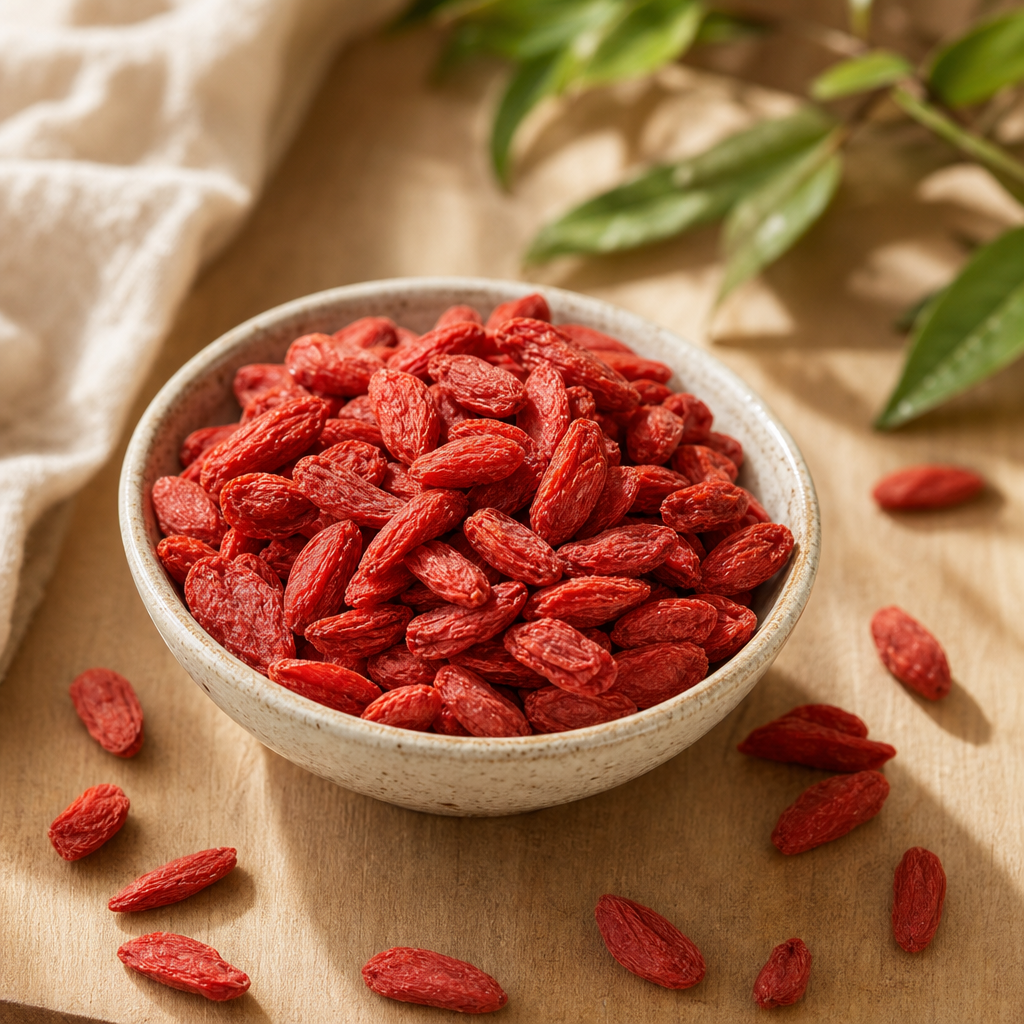
Dried red berries, wrinkled and small, sitting in a glass jar on every Chinese grandmother's kitchen counter. You've probably seen them — goji berries (枸杞, gŭuq&ibreve;), the bright red fruit that has quietly become a global superfood. But long before they appeared in smoothie bowls in Los Angeles, they were a cornerstone of Chinese wellness — brewed into tea, stirred into soup, and nibbled by the handful by people who believed they held the secret to a long and healthy life.
Two Millennia of Trust
Goji berries appear in the Shennong Bencao Jing (神农本草经), China's oldest pharmacopoeia, compiled around 200 AD. The text classified herbs into three grades: superior, middle, and inferior. Superior herbs were those that could be taken long-term without harm — they didn't "treat" disease so much as strengthen the body against it. Goji was classified as superior.
"Goji berry — sweet in taste, neutral in nature. It strengthens the body, brightens the eyes, and when taken over a long period, lightens the body and prolongs life." — Shennong Bencao Jing, circa 200 AD"枸杞,味甘,性平。久服坚筋骨,轻身不老。" —《神农本草经》
What's Actually In These Berries?
Modern science has been catching up with what Chinese medicine knew empirically for centuries. Goji berries are remarkably dense in nutrients: they contain all eight essential amino acids (rare for a fruit), more beta-carotene than carrots, and significant amounts of zeaxanthin — a compound specifically linked to eye health. They're also rich in polysaccharides, which research suggests may support immune function.
Does this mean goji berries will make you live forever? No. But the convergence of traditional knowledge and modern nutritional science is striking. The berry that Chinese herbalists prescribed for "brightening the eyes" turns out to be packed with exactly the compounds your retinas need.
How to Brew Goji Tea
The simplest way: put a small handful of dried goji berries (about 10–15) in a cup, pour hot water (80–85°C / 176–185°F), and let them steep for 5 minutes. The water will turn a pale golden-orange, and the berries will plump up as they rehydrate. Drink the tea, then eat the softened berries — they're slightly sweet, slightly tart, with a texture somewhere between a raisin and a cranberry.
Classic pairings:
Goji + Chrysanthemum (菊花) — the classic "bright eyes" tea, slightly cooling, perfect for screen-weary eyes.
Goji + Red Dates (红枣) — warming and nourishing, a winter favorite, sweet enough that you won't need honey.
Goji + Longan (桂圆) — deeply sweet, calming, often drunk before bed.
Goji + Green Tea — the modern antioxidant powerhouse; add goji to your Longjing or Biluochun.
Choosing Good Goji
Good goji berries are deep red-orange, slightly wrinkled but not shriveled, with a faint fruity scent. Avoid berries that are uniformly bright red — they may have been treated with sulfites. The best goji comes from Ningxia province in northwest China, where the combination of alkaline soil, high altitude, and long sunshine hours produces berries with the highest polysaccharide content.
A simple test: drop a few berries into warm water. Good goji will float and slowly release color. Treated berries will turn the water bright orange almost immediately.
"In China, goji is not a trend. It's not a superfood fad. It's just what your grandmother puts in your tea when you've been studying too hard, and nobody thinks to question it — because it works."