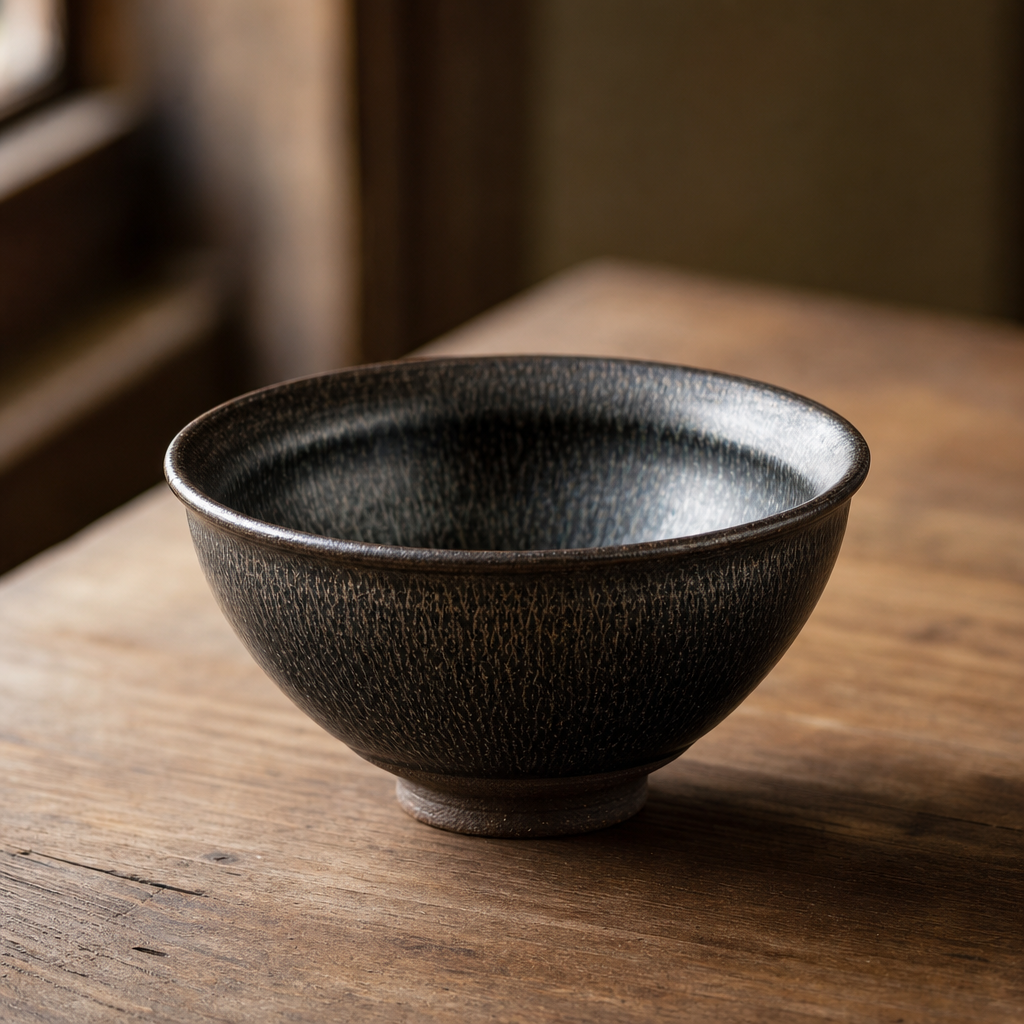
There is a kind of ceramic bowl so dark it seems to swallow light. Hold one in your hands, and you're holding a piece of the Song dynasty — a time when Chinese aesthetics reached a pitch of refinement that still echoes a thousand years later. This is Jianzhan (建盏), and it might be the most understated masterpiece in the history of ceramics.
The Emperor's Tea Bowl
In the Northern Song dynasty (960–1127), tea was not brewed but whisked. Powdered tea was placed in a bowl, hot water poured over it, and a bamboo whisk worked it into a froth. The ideal froth was white — and the ideal bowl to showcase white froth was black. Dark as iron, streaked with silver, the Jianzhan bowl made tea froth look like clouds against a night sky.
Emperor Huizong, himself an aesthete of the highest order, wrote about these bowls in his Treatise on Tea (大观茶论). He preferred the ones with "hare's fur" streaks — fine silvery lines running down the dark glaze like falling rain. Imperial preference turned a regional craft into a national obsession.
"The color of the bowl should be deep black. Those with hare's fur markings are the finest." — Emperor Huizong, Treatise on Tea, 1107 AD"盏色贵青黑,玉毫条达者为上。" — 宋徽宗《大观茶论》
Born from Fire
Jianzhan bowls come from Jianyang in Fujian province, where the local clay is exceptionally rich in iron — up to 10%. This iron-rich clay, combined with a glaze made from local minerals and wood ash, produces effects that no potter can fully control. The kiln decides.
Fired at temperatures exceeding 1300°C (2372°F) for days, each bowl emerges unique. The iron in the clay migrates through the glaze during firing, crystallizing into patterns on the surface. The most famous patterns are:
Hare's Fur (兔毫) — fine silvery-brown streaks, like the fur of a hare. The classic, the emperor's favorite.
Oil Spot (油滴) — silvery dots scattered across the surface, like oil droplets on water. Rarer, more dramatic.
Partridge Feather (鹧鸪斑) — larger, more defined spots resembling a bird's plumage. The rarest and most prized.
Yohen (曜変) — an almost supernatural iridescence, shifting colors in changing light. Only a handful of genuine Yohen bowls survive, all in Japanese collections.
Why Japan Treasured What China Forgot
By the Ming dynasty, Chinese tea culture had shifted. Loose-leaf tea replaced powdered tea, white porcelain replaced black. Jianzhan fell out of fashion in its homeland — but in Japan, where the Song tea ceremony had taken root as chanoyu, these bowls became national treasures.
The most famous Jianzhan bowls in the world — the Yohen Tenmoku — reside in Japanese museums, designated as National Treasures. They are considered, quite literally, priceless. The Japanese word tenmoku itself comes from Tianmu Mountain (天目山) in Zhejiang, where Japanese monks first encountered these bowls.
A single Yohen Tenmoku bowl, held in the Seikado Bunko Museum in Tokyo, has been described as "holding a universe in your hands." Under light, its surface shifts from deep blue to violet to gold — an effect that modern science still cannot fully explain or replicate.
Finding a Jianzhan Today
The craft nearly died out. By the mid-20th century, the techniques for making true Jianzhan were lost. Then, in the 1980s, a group of Chinese ceramicists began to study ancient kiln sites in Jianyang, reverse-engineering the glazes and firing methods. Today, a new generation of potters in Fujian produces Jianzhan bowls that rival the ancients.
A good modern Jianzhan starts around $50 and can reach thousands for a master potter's work. The iron-rich clay means each bowl is subtly magnetic — hold a magnet to it and feel the earth's pull. More importantly, the iron is said to soften water, making tea taste smoother and sweeter.